
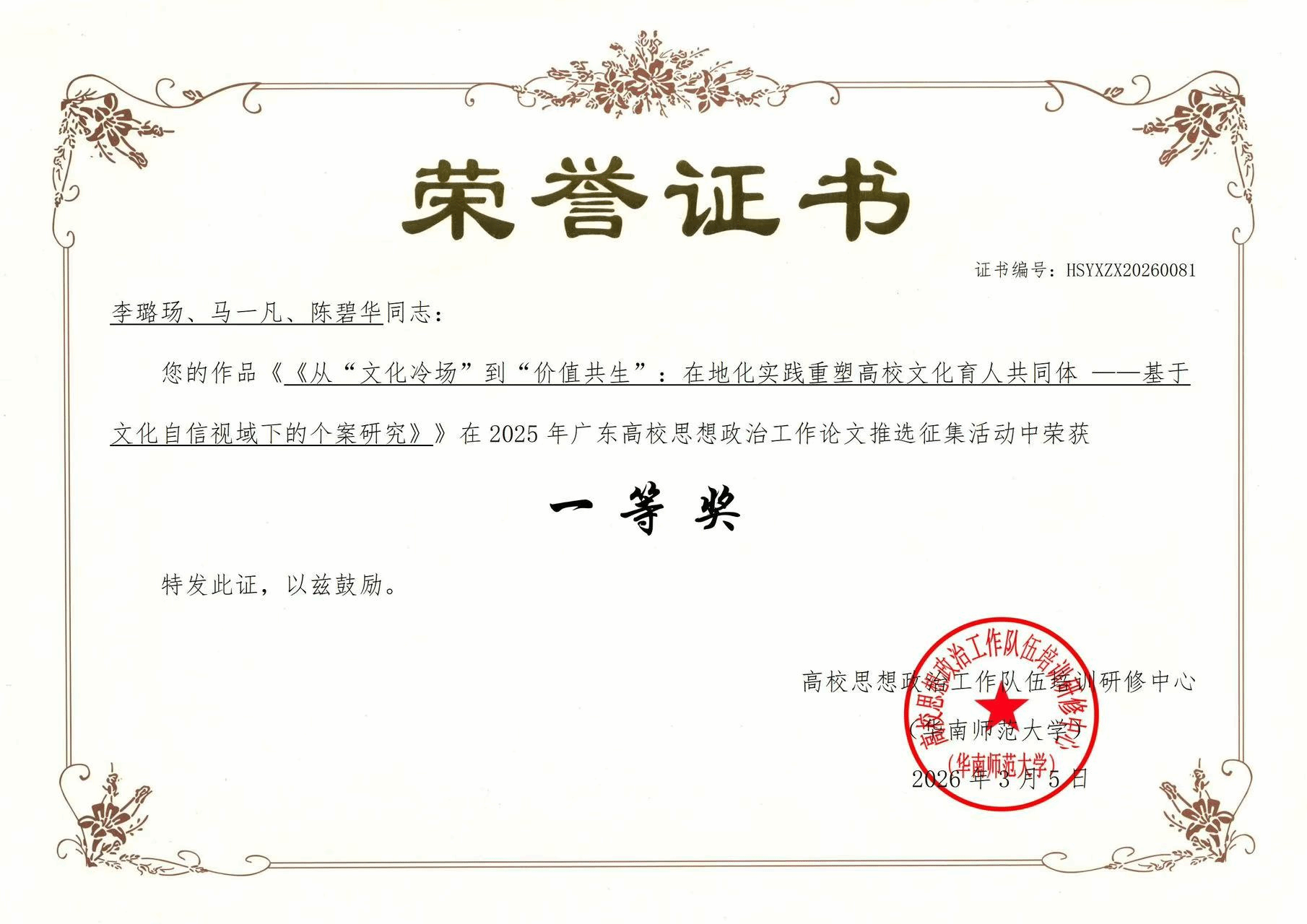
Recently, the results of the 2025 Guangdong Universities Call for Papers, Case Studies, and Online Courses on Ideological and Political Work were announced. Beijing Normal–Hong Kong Baptist University (BNBU) delivered an outstanding performance in this selection. A paper submitted by a team comprising Li Luyang, Programme Director of the Communication Studies Concentration in the Faculty of Humanities and Social Sciences at BNBU, Chen Bihua, Secretary of the First Party Branch of the Graduate School, and Ma Yifan, Publicity Committee Member, was awarded the First Prize. In addition, three work cases submitted by the University received the Third Prize. These achievements not only demonstrate BNBU’s positive progress in the theoretical research and practical innovation of ideological and political work, but also reflect the Faculty of Humanities and Social Sciences’ commitment to supporting student development and jointly fulfilling the fundamental mission of fostering virtue through education.
The event was organized by the Training and Development Center for Ideological and Political Work Teams in Higher Education (South China Normal University). It aimed to further study and implement the guiding principles of the Fourth Plenary Session of the 20th Central Committee of the Communist Party of China and to promote the high-quality development of ideological and political work in higher education. BNBU attached great importance to the event, actively mobilized participation, and carefully organized the submission process. The submitted works demonstrated a high level of theoretical depth and practical value. The award-winning results embody both strong theoretical reflection and a clear practical orientation, fully highlighting the solid professional competence of the University’s ideological and political work team and its positive educational outcomes.
Among the entries, the First Prize paper, titled “From ‘Cultural Apathy’ to ‘Value Symbiosis’: Localized Practice Reshaping the Community of Cultural Education in Universities — A Case Study from the Perspective of Cultural Confidence,” focuses on practical issues in cultural education in higher education institutions. Grounded in localized practice, the paper explores how collaboration between universities and local communities, community integration, and practice-based education can transform university cultural education from one-way transmission to two-way interaction, and from activity-based participation to value symbiosis. It offers valuable insights for the innovative development of ideological and political work in universities in the new era.
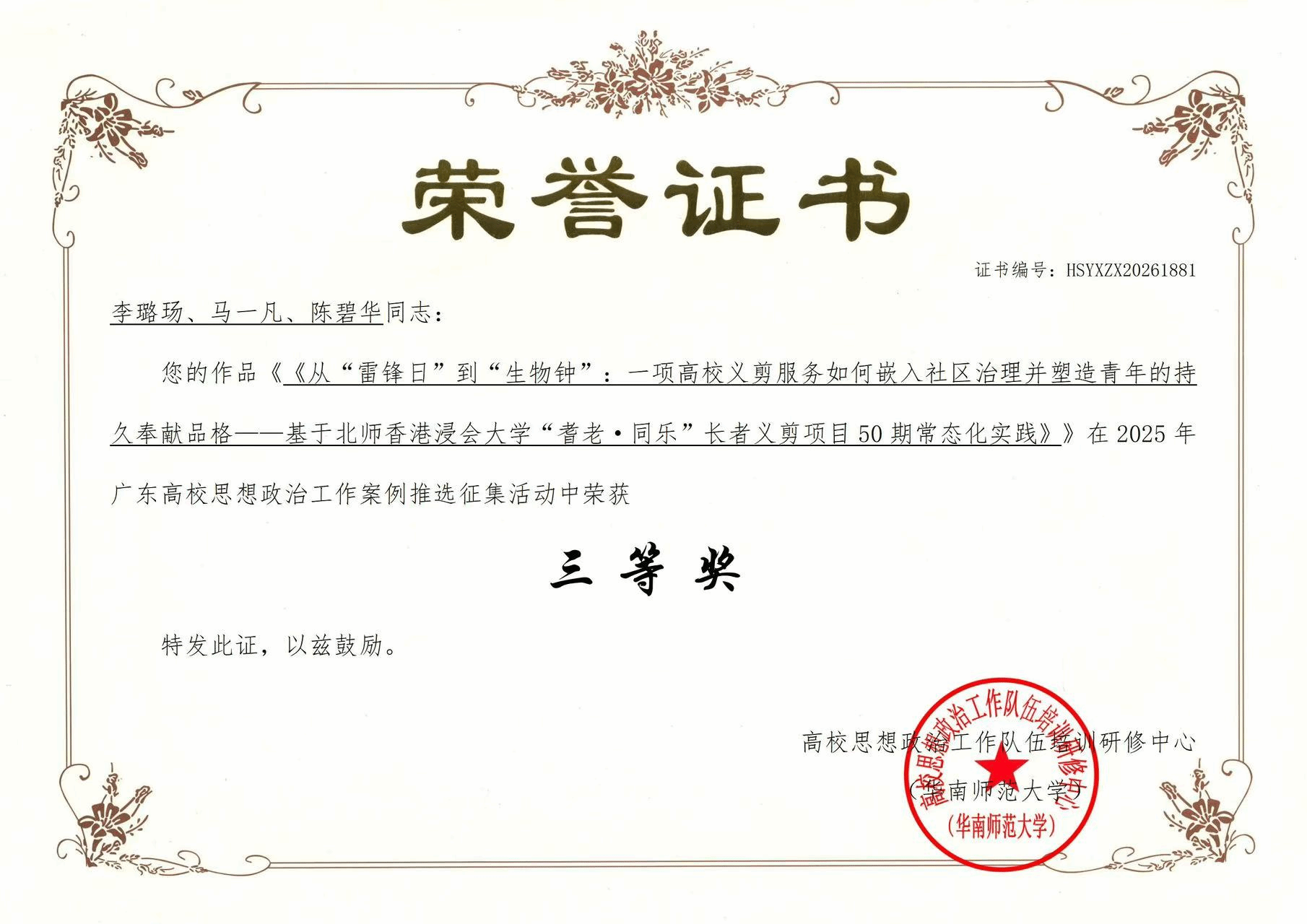
The three Third Prize cases showcase the practical achievements of BNBU’s ideological and political work from different perspectives. The case on cultural education through the inheritance of intangible cultural heritage draws on the distinctive cultural resources of Huitong Ancient Village and organically integrates intangible cultural heritage preservation, cultural immersion, and ideological and political education, guiding students to strengthen their cultural identity and confidence through immersive practice. The case on psychological education through volunteer haircut services is rooted in community service needs and uses regular volunteer service as a vehicle to help students cultivate character and foster a sense of responsibility while serving the public and contributing to society. The case on industry-empowered online education focuses on rural industrial development and youth expression in digital spaces. By leveraging students’ professional expertise and the strengths of new media, it supports the promotion of local specialty industries and enhances the effectiveness of online education while contributing to rural revitalization. Collectively, these achievements reflect BNBU’s active exploration of the deep integration of teaching, practice, and education. They also represent important outcomes of the University’s localized practice in Huitong Ancient Village and its efforts to promote collaborative innovation in ideological and political work in higher education.
Looking ahead, the Communication Studies Concentration will take this recognition as an opportunity to continue focusing on the fundamental mission of fostering virtue through education, align more closely with the University’s overall development, refine its distinctive strengths, build signature initiatives, and deepen research into the principles and practical innovation of ideological and political work. It will continue to promote the close integration of ideological and political education with local cultural heritage, rural revitalization practices, and regional development needs, so as to fully leverage the guiding role of ideological and political work. The Faculty of Humanities and Social Sciences will also continue to build on its educational strengths, support postgraduate training and development, and make greater contributions to serving the development of the Guangdong–Hong Kong–Macao Greater Bay Area, building consensus among young people, and cultivating a new generation capable of shouldering the mission of national rejuvenation.


Award Certificate
