
On 26 March, the Department of Communication at the Faculty of Humanities and Social Sciences, Beijing Normal-Hong Kong Baptist University, invited Prof. Dr. Kai-Uwe Hellmann, a Berlin-based sociologist and a leading authority in consumer and economic sociology, to deliver an academic lecture titled “The Endgame of Media Reality: From Mass Media to Fragmented Worlds” in T7-104. From his sharp system-theoretical perspective, Prof. Hellmann analysed how the “shared reality” once constructed by mass media is disintegrating under the multiple impacts of social media, artificial intelligence, and decentralised content production, accelerating humanity’s entry into a fragmented media ecosystem where multiple realities coexist. The lecture was moderated by Prof. Dr. Markus G. T. Heidingsfelder from the Department of Communication.

Prof. Dr. Kai-Uwe Hellmann delivers a lecture on “The Endgame of Media Reality: From Mass Media to Fragmented Worlds” at BNBU.
Prof. Hellmann opened the lecture by quoting the renowned German sociologist Niklas Luhmann: “Whatever we know about our society, or indeed about the world in which we live, we know through the mass media.” He pointed out that mass media have never truly provided a “single” shared reality, but have always transmitted multiple, often conflicting versions of reality. The key issue is not whether the media “represent” reality, but how the public can discern the boundary between truth and falsehood when trust in media begins to fracture.
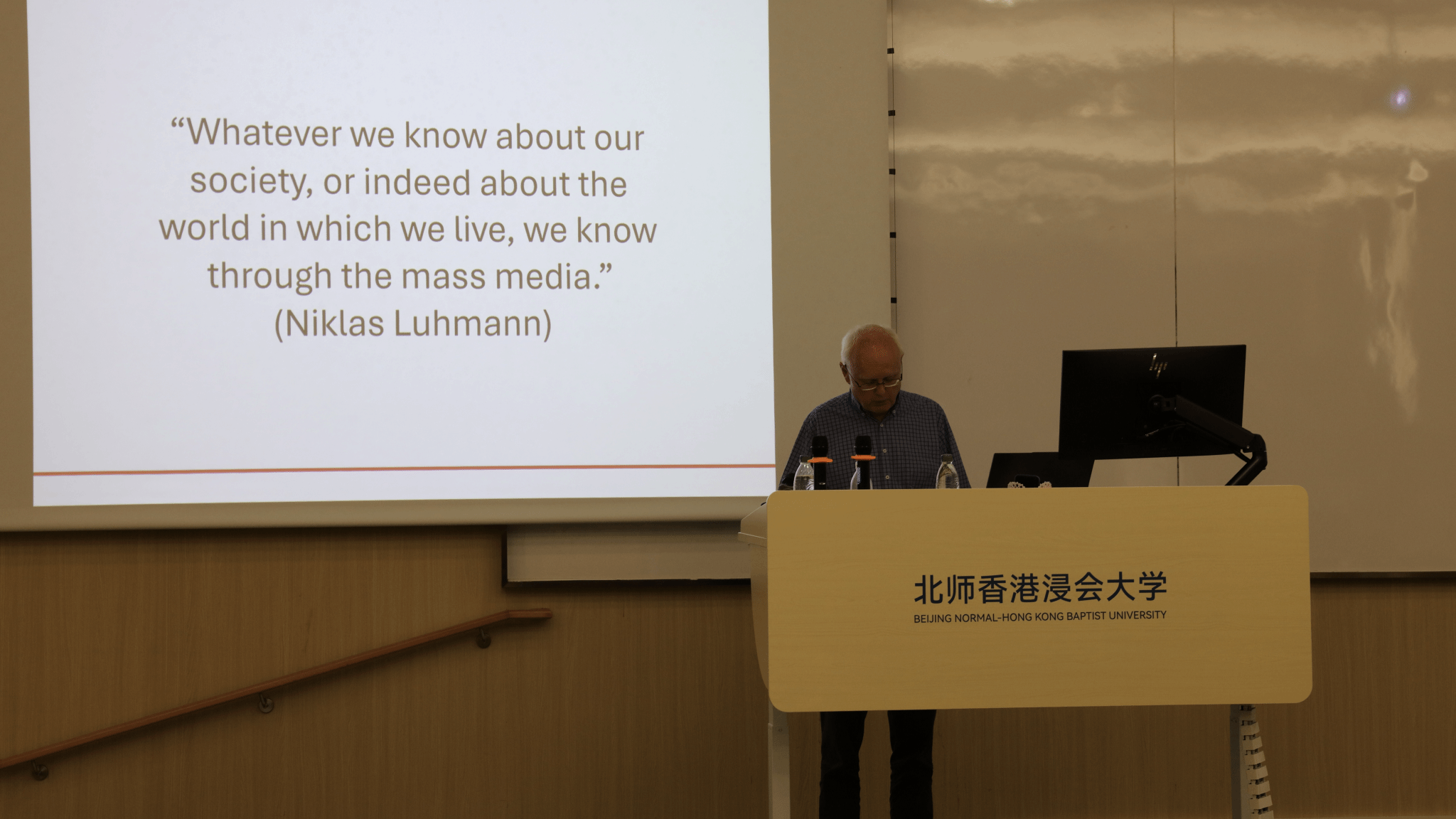
Prof. Hellmann opens with Niklas Luhmann’s insight on mass media and the blurred line between truth and falsehood.
Using the 2013 scifi film Ender’s Game as an entry point — in which the young prodigy Ender Wiggin unknowingly turns a simulated training exercise into a real act of genocide against an alien species — Prof. Hellmann drew an analogy to the paradox of contemporary media society: we may believe we are living in an objective reality constituted by facts, but in fact we may be immersed in a vast “simulation” constructed by the media, actively participating in the game without even realising it.
Prof. Hellmann systematically traced several theoretical lineages that address the question of “media reality.” He began with the French thinker Jean Baudrillard’s concepts of “hyperreality” and “simulacra”: media no longer seek to represent a preexisting “original,” but instead generate reality themselves — signs and images become more “real” than reality itself, while reality recedes into the background. He then turned to the American historian Daniel Boorstin’s classic analysis of the “pseudoevent,” noting that even “news” in the mass media age has long been a carefully staged and packaged product.

Prof. Hellmann draws on Umberto Eco’s “Faith in Fakes” and Pierre Bourdieu’s “illusio” to unpack our collective belief in constructed realities.
Prof. Hellmann also drew on the Italian semiotician Umberto Eco’s Faith in Fakes, highlighting modern society’s collective belief in simulacra — the tendency to immerse oneself in finely crafted fake realities rather than confront the rough edges of the authentic. Towards the end of the lecture, he introduced Pierre Bourdieu’s concept of “illusio” — the shared belief that “the game is worth the candle” — to remind the audience that every individual in today’s media environment is not only a “constructed subject” of multiple realities but also an unwitting participant in sustaining and reproducing the game.

Prof. Dr. Markus G. T. Heidingsfelder moderates the lecture.
With the rapid advancement of artificial intelligence, Prof. Hellmann argued that the theoretical dilemmas outlined above are being pushed to their extreme. AI can generate, remix, and amplify multiple realities at a scale and speed never seen before. More importantly, it renders the boundary between the “real” and the “fabricated” almost indistinguishable. As deepfakes, algorithmically generated “news,” and automated disinformation campaigns flood the public sphere, the traditional functions of mass media — factchecking and consensusbuilding — face unprecedented collapse.

Prof. Dr. Markus G. T. Heidingsfelder presents a souvenir to Prof. Dr. Kai-Uwe Hellmann.
Prof. Hellmann concluded with a provocative question: “Are we witnessing the end of mass media as we knew it — without anything to replace it?” He pointed out that the “reality monopoly” once established by mass media is disintegrating, yet new mechanisms for consensus-building have yet to emerge. A sober observation of the structural transformation currently reshaping the media landscape is extremely important. During the Q&A session, faculty and students engaged in lively discussion with Prof. Hellmann on topics such as the future of media.

Prof. Hellmann shares his insights with the audience during the Q&A session.