
On 20 April, the Department of Communication at the Faculty of Humanities and Social Sciences, Beijing Normal-Hong Kong Baptist University (BNBU), invited Prof. Dr. Guo Yu from the Faculty of Humanities and Arts at the Macau University of Science and Technology to deliver a lecture titled “Artificial Intelligence in Promoting the Public’s Intention for Climate Change Mitigation: Perspectives from the Infotainment Strategy” in T2-102. Drawing on his multifactorial experiment, Prof. Guo demonstrated how AI-generated infotainment content can effectively encourage public engagement in climate change mitigation through situational perception pathways. The lecture was moderated by Prof. Li Yiwei, Assistant Professor of the Department of Communication.
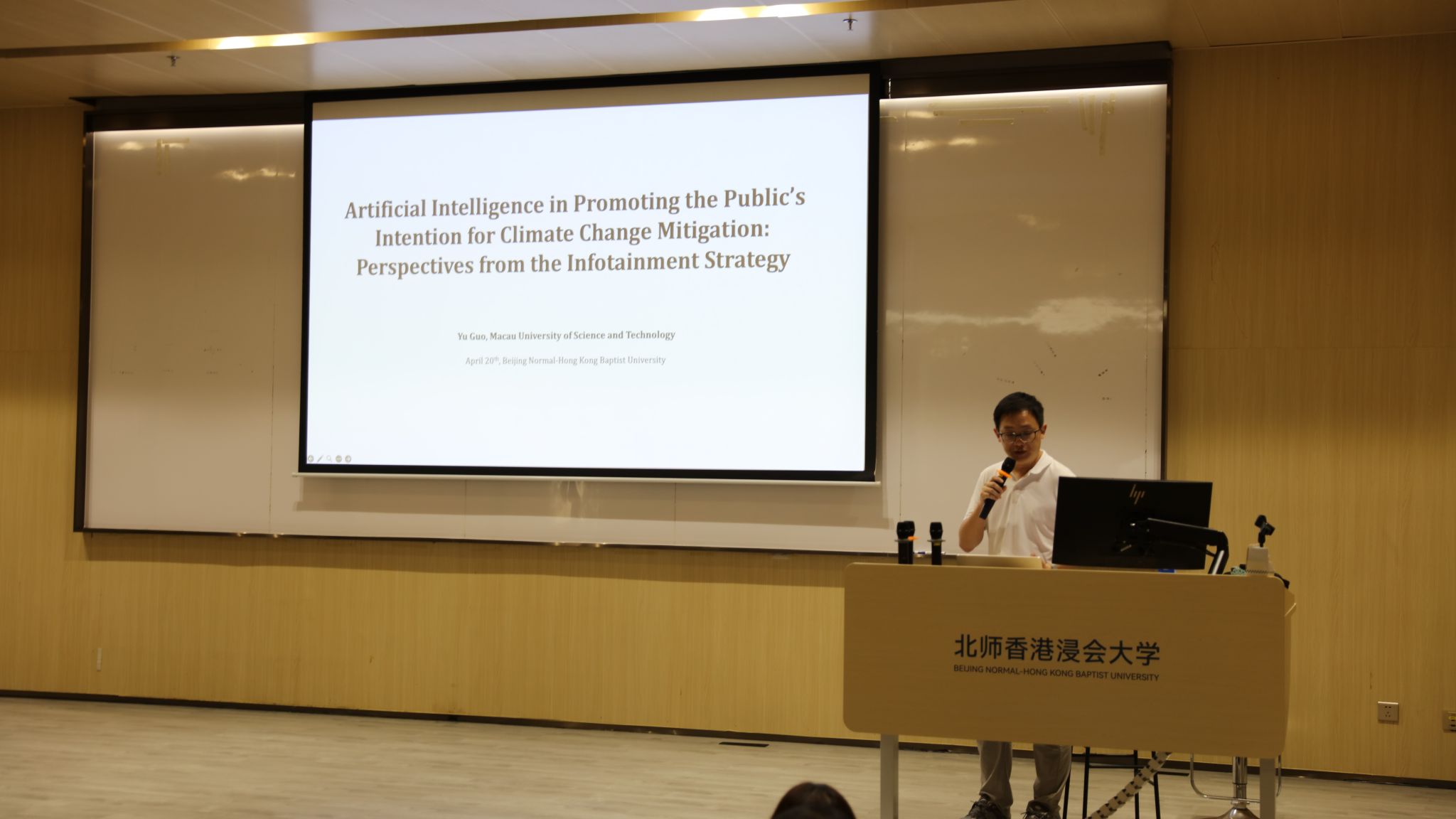
Prof. Guo Yu delivers a lecture on using infotainment strategies to drive public engagement in climate mitigation at BNBU. (Photo by Fu Yingzhi)
Prof. Guo opened by noting that, although the scientific community agrees that climate change poses a serious threat to human survival, traditional science communication often relies on rational data and text, which fails to reach public emotions and interests. To bridge this gap, he proposed the infotainment strategy—combining entertainment with factual accuracy to make scientific information more engaging. Prof. Guo elaborated on the unique advantages of using comics as an infotainment strategy over text-only narratives: sequential panels reduce cognitive load, visual metaphors make abstract threats salient, and character-driven stories evoke worry and a sense of responsibility.
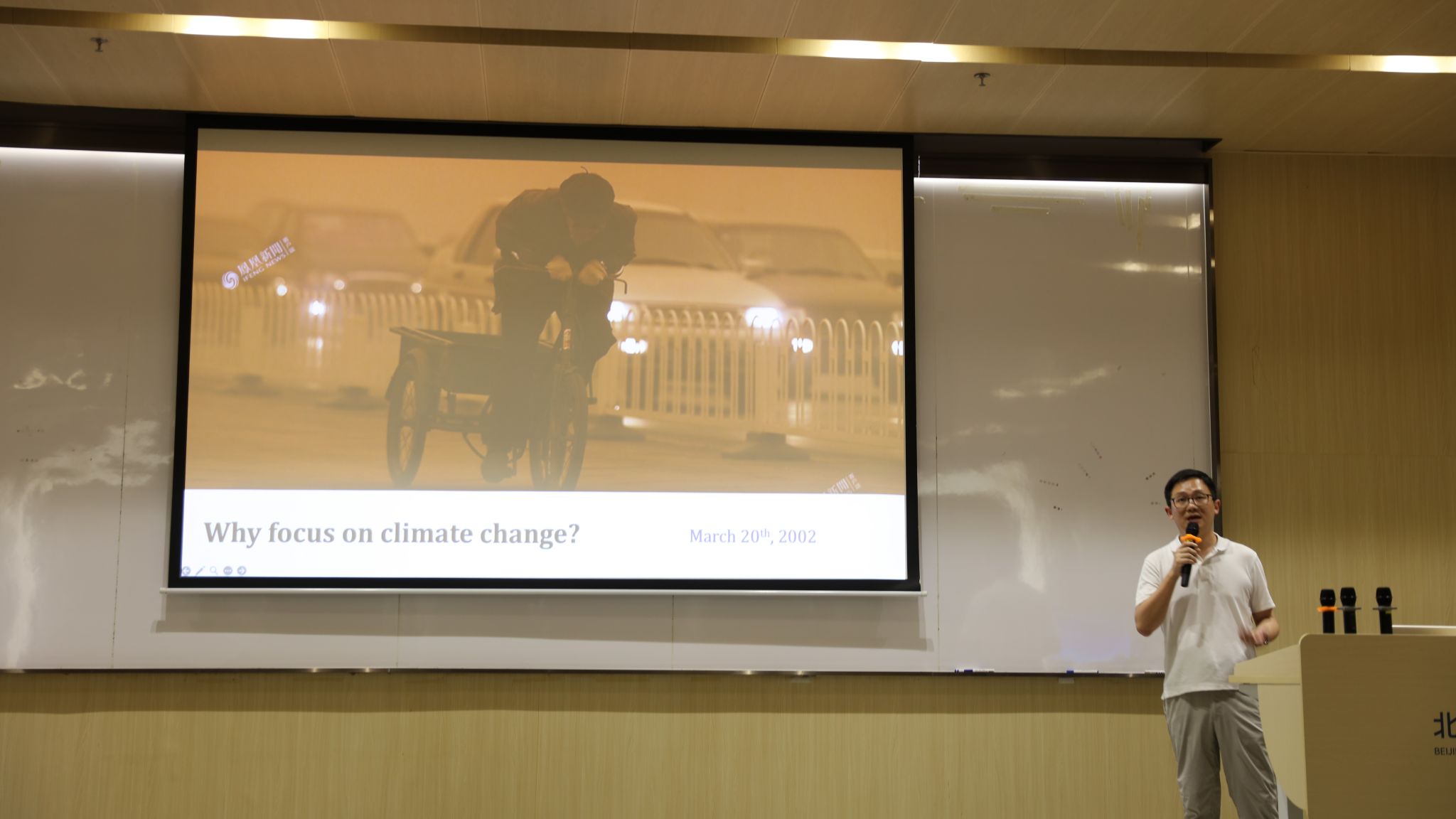
Prof. Guo explains the cognitive advantages of comics as an infotainment strategy. (Photo by Fu Yingzhi)
A core innovation of this research lies in the use of AI. Prof. Guo introduced how his team used Midjourney to input text scripts as descriptive prompts and directly generate sequential visual narrative panels. The key breakthrough is that skilled artists are no longer required, enabling efficient, scalable production of high-quality science comics. Experiments confirmed that participants did not evaluate AI-generated comics negatively compared to human-made ones AI-generated content is now a viable and scalable method for environmental infotainment production.
Prof. Guo’s research is grounded in the Situational Theory of Public, examining how two core situational perception variables—problem recognition and constraint recognition—interact with narrative format to shape behavioural intentions. The study employed a 2×2×2 factorial experiment, testing the main and interaction effects of narrative format (comics vs. text-only), problem recognition (high vs. low), and constraint recognition (high vs. low). Key findings: comics generate higher behavioural intentions for climate change mitigation than text-only narratives; high problem recognition and low constraint recognition each independently predict higher intentions; and the combination of comics, high problem recognition, and low constraint recognition produces the highest intentions across all conditions. Additionally, climate change information seeking (active route) and information processing (passive route) mediate these effects. Active seeking translates more effectively into action than passive exposure—incidental exposure is insufficient to drive behavioural change; deep cognitive elaboration is the critical pathway.
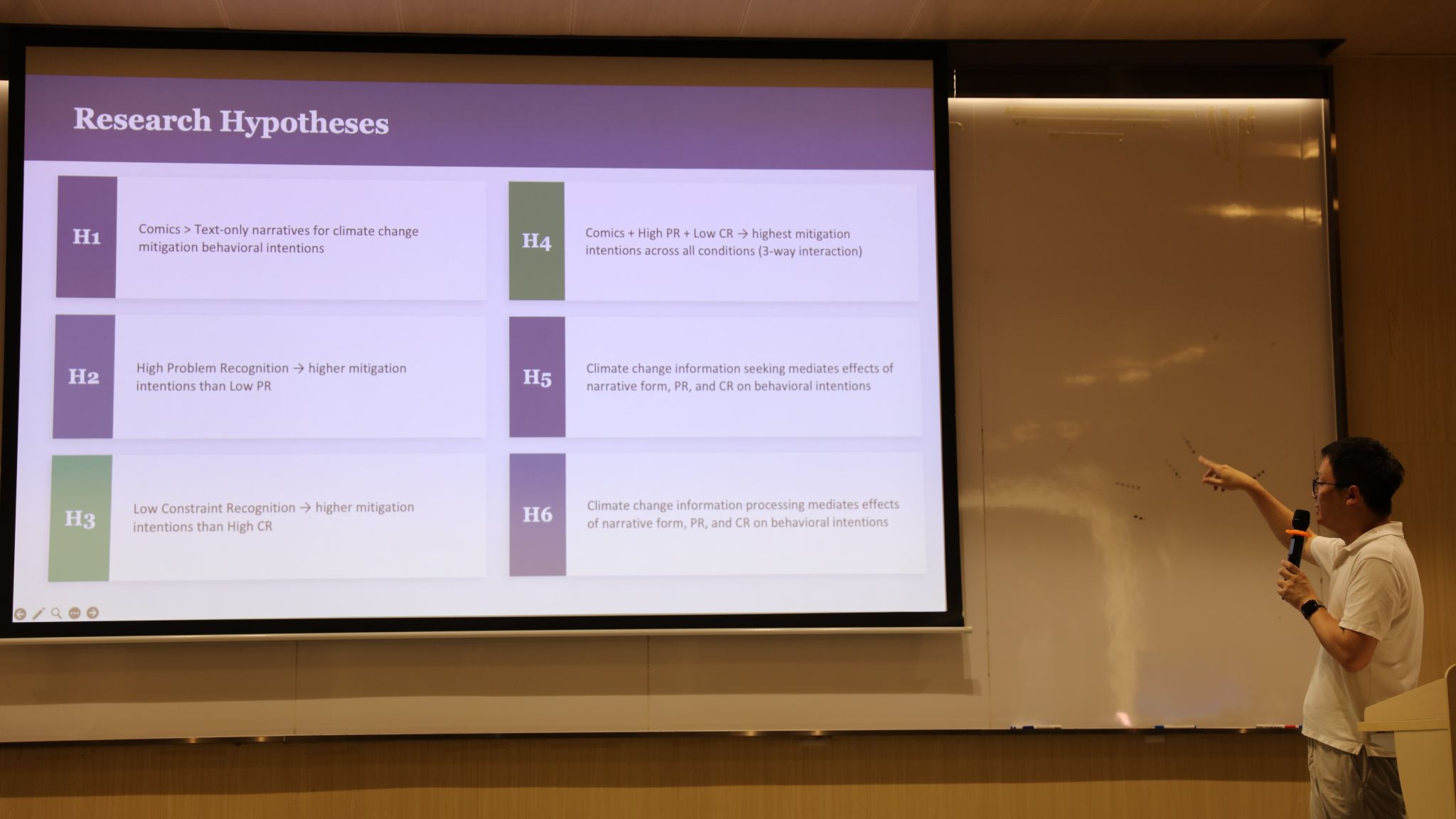
Prof. Guo presents the experimental hypotheses and methods. (Photo by Fu Yingzhi)
Prof. Guo further explained a key insight: when problem recognition is already high, audiences prefer detailed text; but when problem recognition is low, visually rich comics capture attention and create emotional salience that text cannot achieve. Comics also excel at reducing constraint recognition: by visually demonstrating actionable steps, comics show feasibility more effectively than text, reducing perceived barriers and directly boosting self-efficacy.
Theoretically, this research extends the Situational Theory of Public into the infotainment domain and validates it for climate change communication beyond text-only stimuli. Comics amplify STP mechanisms by enhancing problem recognition and reducing constraint recognition. Practically, Prof. Guo recommended using AI tools like Midjourney to scale low-cost comic production for environmental campaigns, combining high-threat framing with actionable individual steps within the same message, and including specific action guidance to lower perceived constraints. For low-engagement audiences, he advised leading with comics rather than text, and designing for active engagement.
Prof. Li Yiwei presents a souvenir to Prof. Guo Yu after the lecture. (Photo by Fu Yingzhi)
This lecture offers important implications for climate communication research: AI-generated infotainment content is not merely a “sugar coating” for information, but can systematically reshape public risk perception and action motivation through situational pathways. As AI technology advances rapidly, integrating it with evidence-based communication strategies will be key to promoting public engagement in global issues.
(Author: Fu Yingzhi)