
On 13 March, the Department of Communication (DCom) and the Center for Creative Media & Communication Research (CCMCR) at the Faculty of Humanities and Social Sciences, Beijing Normal-Hong Kong Baptist University (BNBU), co-hosted a lecture titled AI, Agency, and Power Geometries. The event featured Professor John Downey, Pro Vice-Chancellor of Loughborough University, Fellow of the Academy of Social Sciences in the UK, and Member of Academia Europaea, as the keynote speaker. Professor Huang Yu, Dean of the Graduate School at BNBU, and Professor Jesse Owen Hearns-Branaman, Head of the Department of Communication, joined faculty members and students in attending the event.
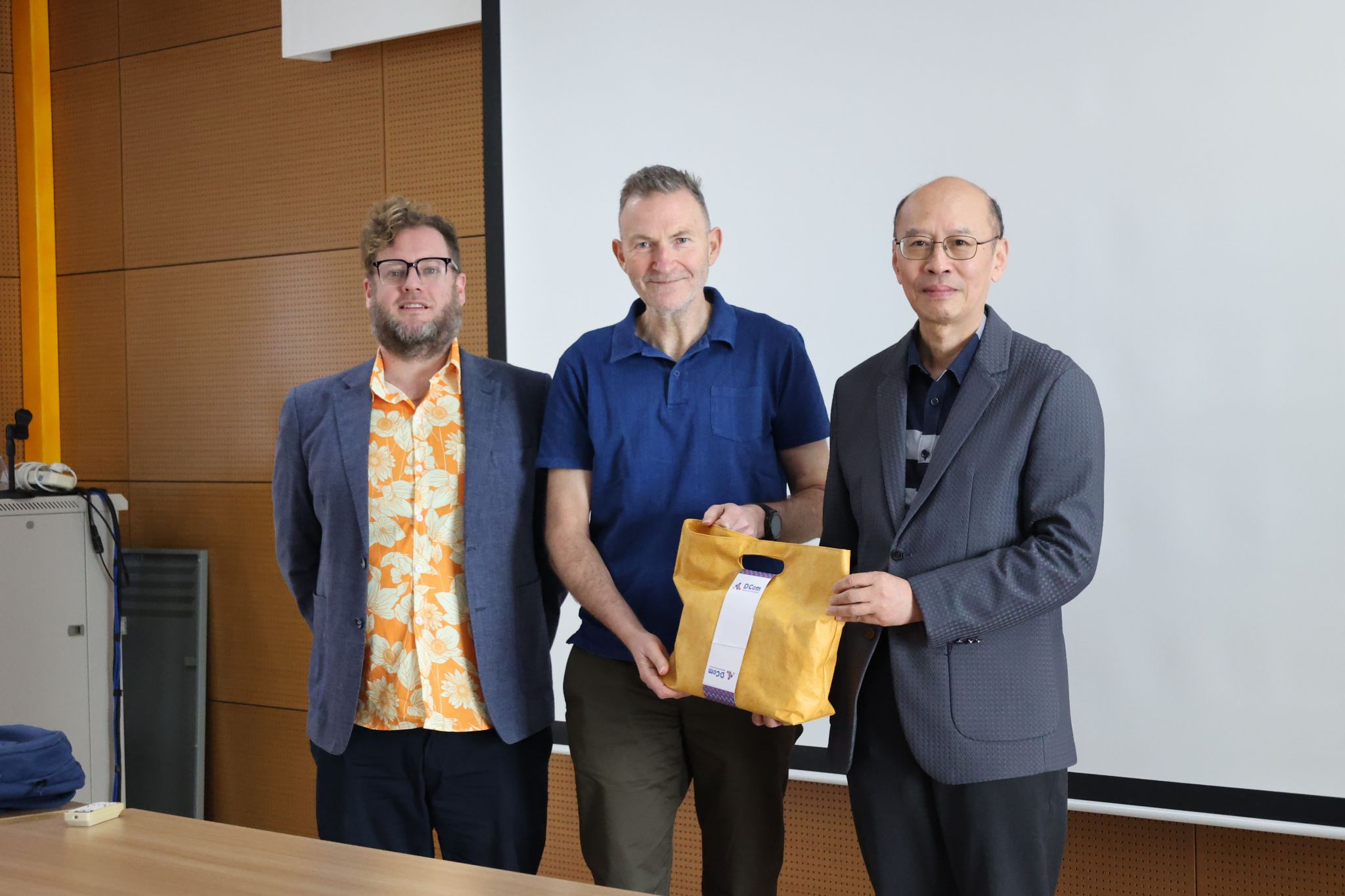
Dr. Jesse Owen Hearns-Branaman (left), Head of the Department of Communication, and Professor Huang Yu (right), Dean of BNBU Graduate School, present a souvenir to Professor John Downey (center).
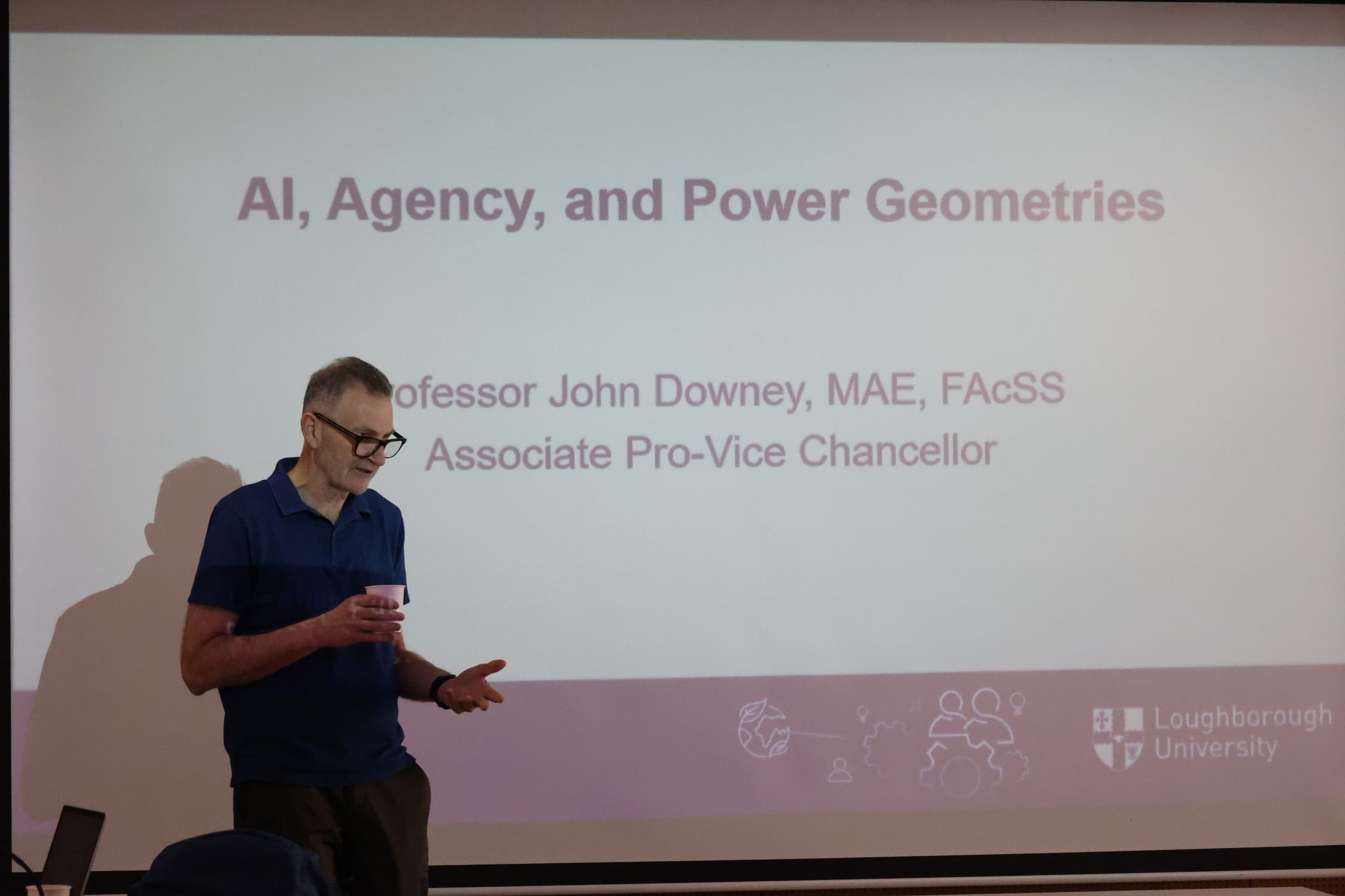
Professor John Downey delivers a keynote lecture.
In his lecture, Professor Downey examined the development of artificial intelligence in relation to local contexts, social realities, and global disparities. He argued that AI is not merely a technical issue but is deeply embedded in specific social and cultural settings. Central to his analysis was the reshaping of power relations—structural asymmetries in access to data, algorithms, and technological sovereignty exist not only between humans and AI agents but also among different social groups and nations, with technology serving as a critical amplifier of existing inequalities.
Professor Downey identified three key tensions between the promises and realities of AI: the concentration rather than equitable distribution of technological benefits; the erosion of boundaries between the real and the virtual in AI-mediated intimacy; and the latent risk that reliance on AI may undermine human creativity. He further elaborated on the structural dynamics of “technological hegemony,” noting that while developed countries dominate AI research and application, developing countries often bear the environmental costs of AI production chains without reaping proportionate benefits.
Addressing ongoing copyright disputes, Professor Downey observed that the extensive use of copyrighted materials in AI training has intensified conflicts between corporate interests and creators’ rights. He emphasised that the current AI transformation represents not an ordinary technological upgrade, but a fundamental restructuring of labour, cognition, and social relations. In light of these changes, he stressed the enduring value of independent thinking, critical capacity, and human creativity, calling for educational approaches that foster equitable and responsible human-AI collaboration.
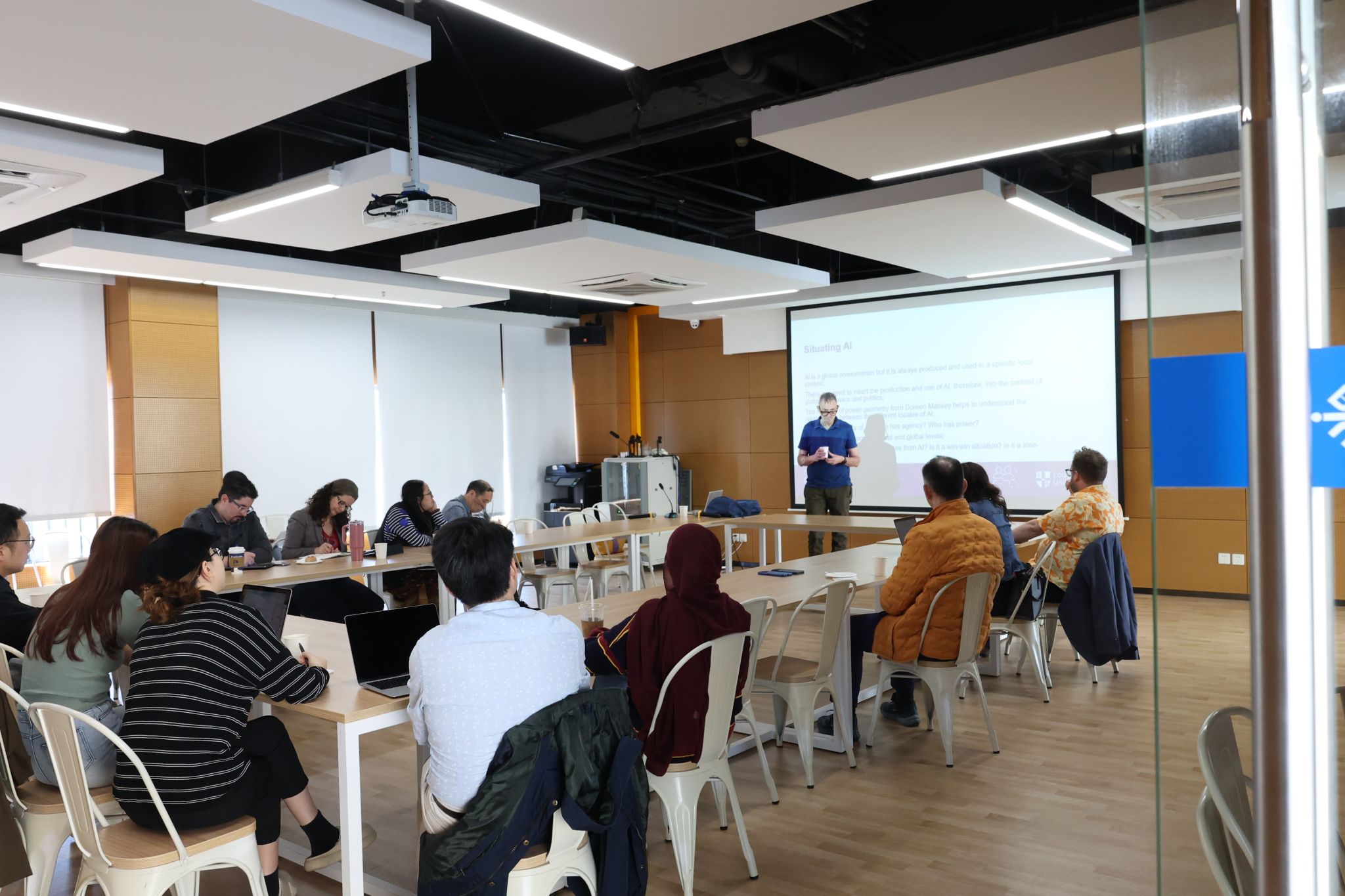
Professor John Downey engages in discussion with faculty members.
The lecture concluded with a lively Q&A session, during which Professor Downey engaged warmly with faculty members, creating an interactive and intellectually vibrant atmosphere.
Editors: Rainie Chen Yutong / Sammy Chen Shanyan
Photographer: Chen Lu
©2024-2025 Beijing Normal-Hong Kong Baptist University(BNBU).All Rights Reserved.粤ICP备07509519号粤公网安备44049102496044.
