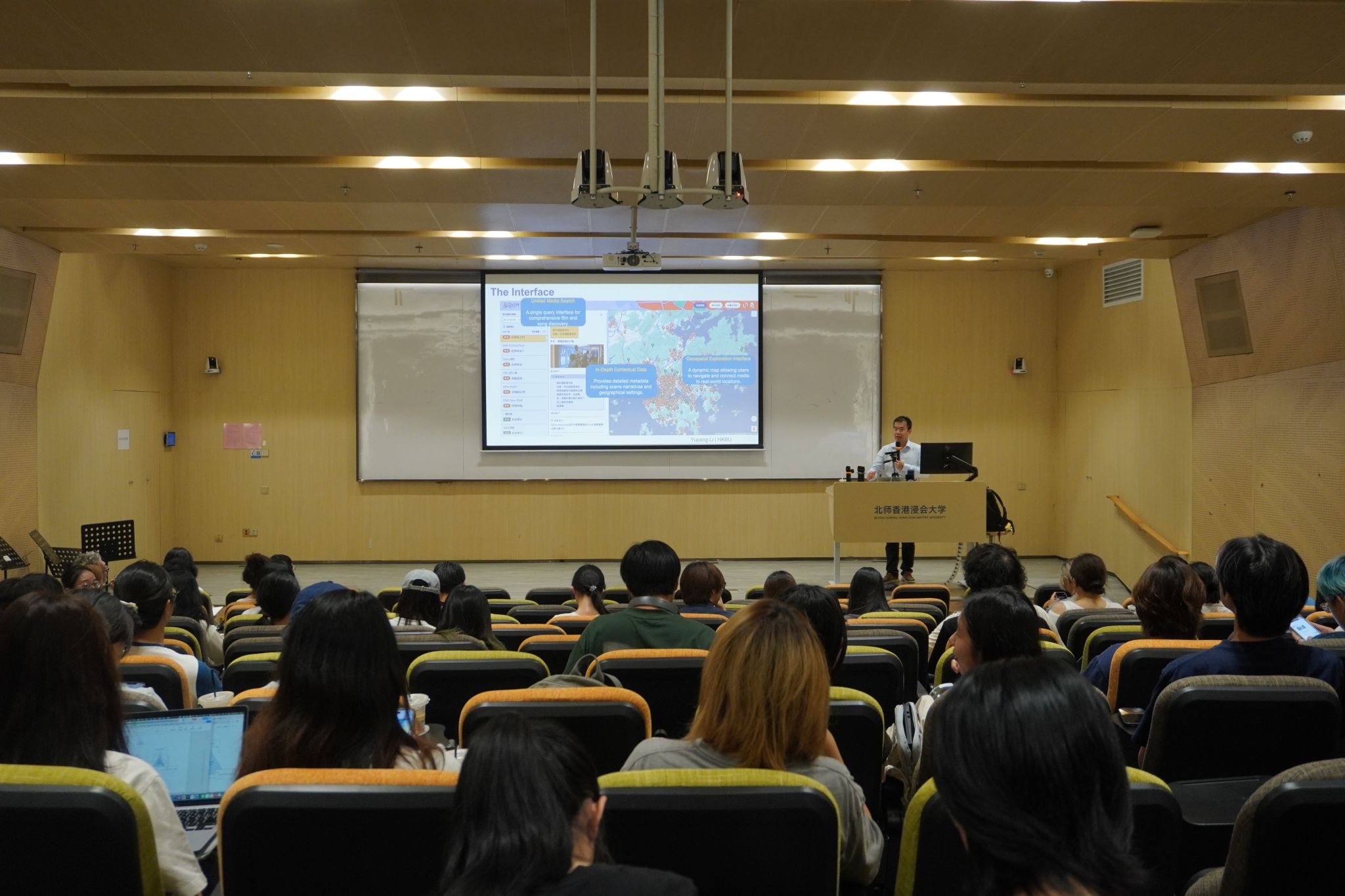
On 29 September, from 12:00 to 13:30, the second lecture in the Transdisciplinary Digital Humanities Lecture Series was held in T2-102. Yupeng Li, Associate Professor in the Department of Interactive Media at Hong Kong Baptist University, spoke on “The Hong Kong Pop Culture Map: Digital Humanities through AI for Good.” He projected a map densely marked with film locations, place names from lyrics, and metro stations, and addressed an interesting question: how can a cultural map awaken the memory of a city? The lecture also explored the literacies and competencies needed in the age of AI.
A Map You Can Search in Both Directions
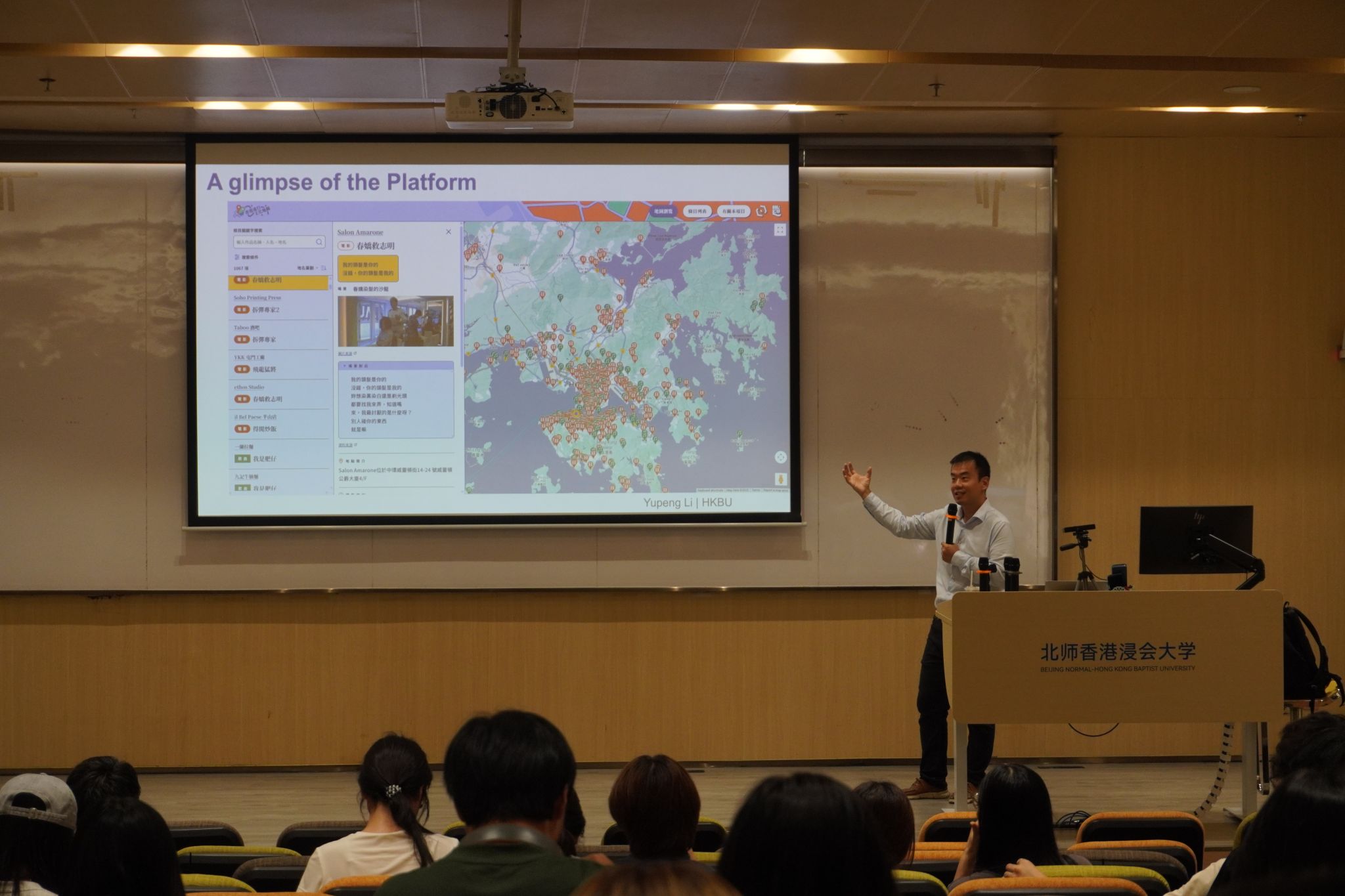
The Hong Kong Pop Culture Map is an interactive geospatial platform that connects films and songs with real places. Users can explore locations associated with a work, or discover works linked to a location.
Searching for Chungking Express brings up locations associated with the film, with entries providing relevant dialogue, scene descriptions and production information. Users can also start from a location on the map to discover associated films and songs. Standing on a street in Siu Sai Wan you can ask which songs were sung about this area, and which shots were framed here.
He demonstrated it live. Dragging the map east along Hong Kong Island, a footbridge from a lyric surfaced. “This is an example one of my students gave me. He likes MC Cheung’s A Gentleman's Guide to Old-Fashioned Dating.”
In 2025, the platform won Best DH Data Visualization at the Digital Humanities Awards. He said the team is in talks with the MTR and tourism bodies, hoping to connect the map to real travel itineraries.
Finding Links Between Works and Places in Check-in Photos
Film lists are easy to find. The hard part is the relation: which line of lyrics, which frame, belongs to which coordinate.
He started with lyrics. Geographical clues are scattered across a large body of lyrics and film footage. Identifying them and verifying their links to real places takes substantial time.
So the team took a different entrance: social media check-in posts. Fans post “checking in at Tin Hau station” on Xiaohongshu, with station signs, shopfronts and footbridges in the background. “These are the clues.” They wrote their own crawlers, then went back to lyrics, films, metro data, roads and buildings to check each match.
The scraped materials cannot be published directly. The team uses AI-powered fact-checking techniques for data cleaning and clue screening, and combines them with a human-machine collaboration paradigm to verify the correspondence between works and locations.
The Hardest Step: Confirming Which Building It Was
In Shock Wave 2, one scene is labelled as having been filmed at “Andy Plaza.” Student assistants followed the records and pinned the coordinates; everything seemed in order. Before the map went live, however, someone familiar with Hong Kong pointed out that it was the wrong building.
“There are two buildings in Hong Kong with the same name,” Li explained. Identifying the correct one required background knowledge, contextual understanding, and even a certain local geographical intuition. “Achieving fact-checking that is fast, accurate, and reliable remains a highly challenging task. Simply labelling something as true or false is not enough to persuade people.”
He used Associate Professor Xu Xi as an example: “Is Professor Xu wearing a pink shirt today?” A student then presented a complete chain of reasoning, first confirming whether the person actually exists, then seeking evidence, and finally comparing the evidence with the claim before drawing an inference.
“Excellent. That is the mindset of a professional fact-checker. Our team is committed to developing real-time, scalable fact-checking capabilities to address the explosive growth of false information. Neither humans nor AI alone can handle this task effectively; only a new paradigm of human-machine collaboration can truly solve complex real-world problems.”
Literacies and Competencies in the Age of Human-AI Symbiosis
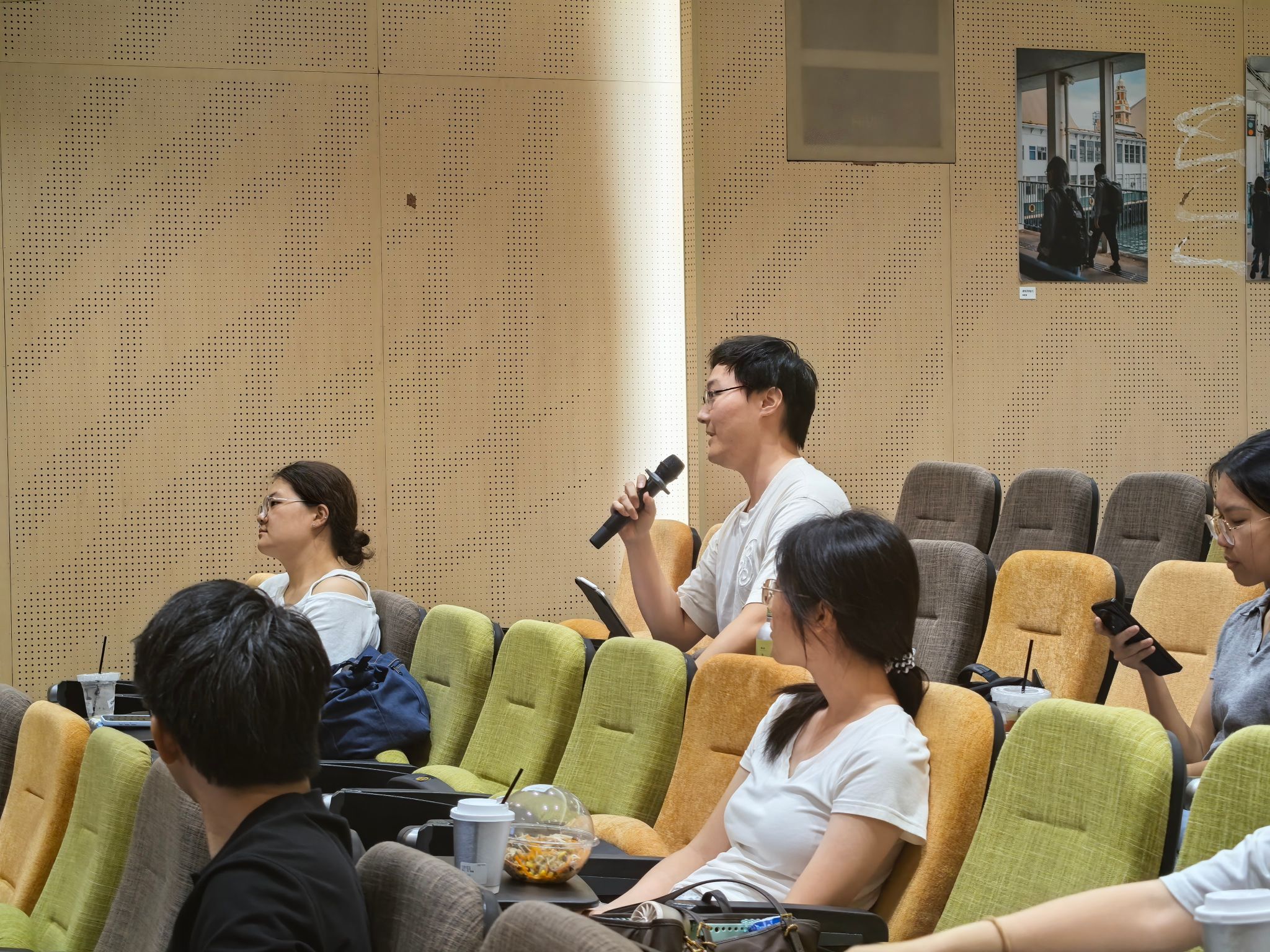
Addressing the first-year students in the audience, Associate Professor Yupeng Li outlined five core competencies: critical thinking, creativity, AI-enabled transdisciplinary research, learning how to learn, and human-machine collaboration.
“AI can sound completely correct,” he said. “Do not accept its output without judgement.” He also emphasised the need to actively respond to the development of AI. For this reason, he prefers to push students toward real problems: there is no need to rush into publishing papers; instead, they should choose a question they are genuinely interested in and pursue it in depth. “In the age of AI, everyone and every discipline stands on the same starting line.”
At the end of the lecture, Professor Li displayed a line from Ashes of Time: “Everyone goes through this stage. When you see a mountain, you always want to know what lies beyond it.”
“You have just started university. You are curious, and you are also confused. That is a good state to be in. Because you are young, and being young is truly wonderful.”
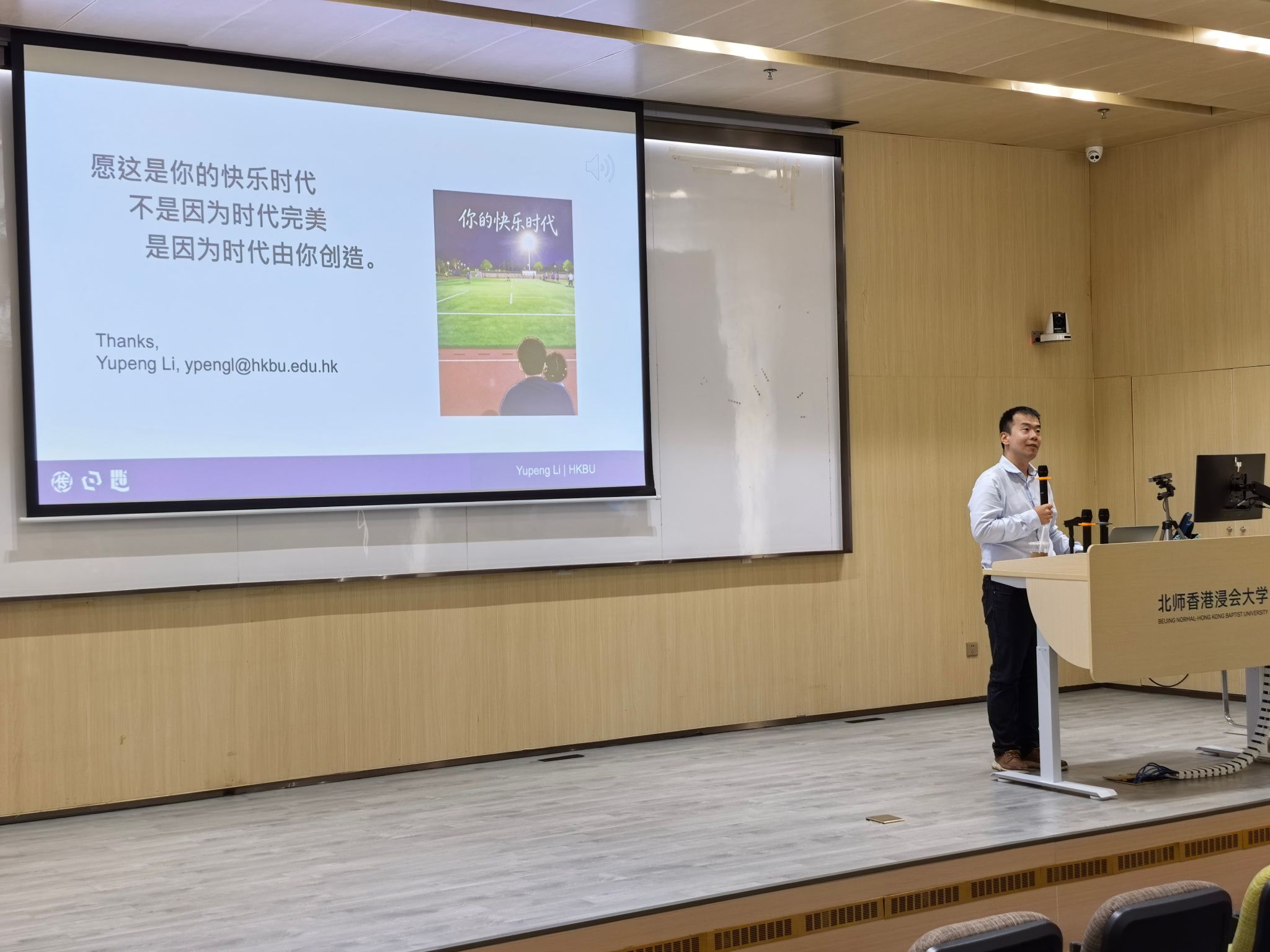
The final slide remained on screen with these words:
May this be your happy era, not because the era is perfect, but because the era is created by you.
About the Speaker
Yupeng Li is an Associate Professor in the Department of Interactive Media at Hong Kong Baptist University and Director of the AI and Social Good Lab at the AI Media Centre. His research spans Societal AI, human–AI collaboration, digital health, networking, and public-facing digital humanities. He applies AI to social-good challenges including fact-checking against misinformation, sign language translation, and trustworthy networking. Prof. Li is Information Director of ACM Transactions on Social Computing. He was named a Microsoft Research Asia StarTrack Scholar. He is a recipient of the International Press Prize at the Geneva International Exhibition of Inventions, the Digital Humanities Award, HKBU’s Knowledge Transfer Award, and President’s Award for Outstanding Performance in Research.
The Transdisciplinary Digital Humanities Lecture Series will continue to invite speakers from different fields. Stay tuned for upcoming sessions.
©2024-2025 Beijing Normal-Hong Kong Baptist University(BNBU). All Rights Reserved.粤ICP备07509519号粤公网安备44049102496044.