From Classroom to Crossroads: BNBU Students Trace Southeast Asia’s Histories and Connections Across Laos, Singapore, and Malaysia
July 2026 —What does it mean to truly understand a region? For two BNBU students, it meant leaving the classroom behind and tracing the histories, borders, and everyday lives of Southeast Asia through direct engagement.
Inspired by a foundational General Education course on Southeast Asian history, two junior students majoring in the Public Relations and Advertising (PRA) program at BNBU’s Department of Communication, Faculty of Humanities and Social Sciences—Duan Mingda and Li Zhuhan— turned regional concepts they learned in BNBU classrooms into lived realities this past summer. Duan Mingda ventured to Luang Prabang, Laos, where he conducted historical research and volunteered as an English teacher at a local primary school. Li Zhuhan, while on exchange at the National University of Singapore (NUS), explored cross-border dynamics between Singapore and Johor Bahru, Malaysia, through repeated journeys on the KTM Shuttle Tebrau.
Their summer journeys exemplify the spirit of “unity of knowledge and action”—a core value of BNBU’s liberal arts education that encourages students to see the world not just through textbooks, but through the diverse cultures, places, and connections that shape it.
Education Knows No Borders: Duan Mingda’s Conducts Fieldwork in Luang Prabang
In July 2026, Duan Mingda and his travel companion, Su Shaowei—a junior student majoring in International Economics and Trade at the China’s North Minzu University—boarded the China-Laos Railway from Kunming to Luang Prabang. His mission was to move beyond the historical narratives introduced in his Southeast Asian history course and understand Laos through direct engagement with its education system, wartime legacy, and agricultural realities.
Arranged by the non-profit educational organization “Big Brother Mouse,” Mingda entered a local primary school to teach an English enlightenment class to Grade-One students. After class, he interacted with a Hmong teacher, learning that primary education remains out of reach for many children in Laos, and that English-language resources are particularly scarce. “Big Brother Mouse” works to fill this gap through low-cost educational programs, proving that a single book can open a world of possibilities.
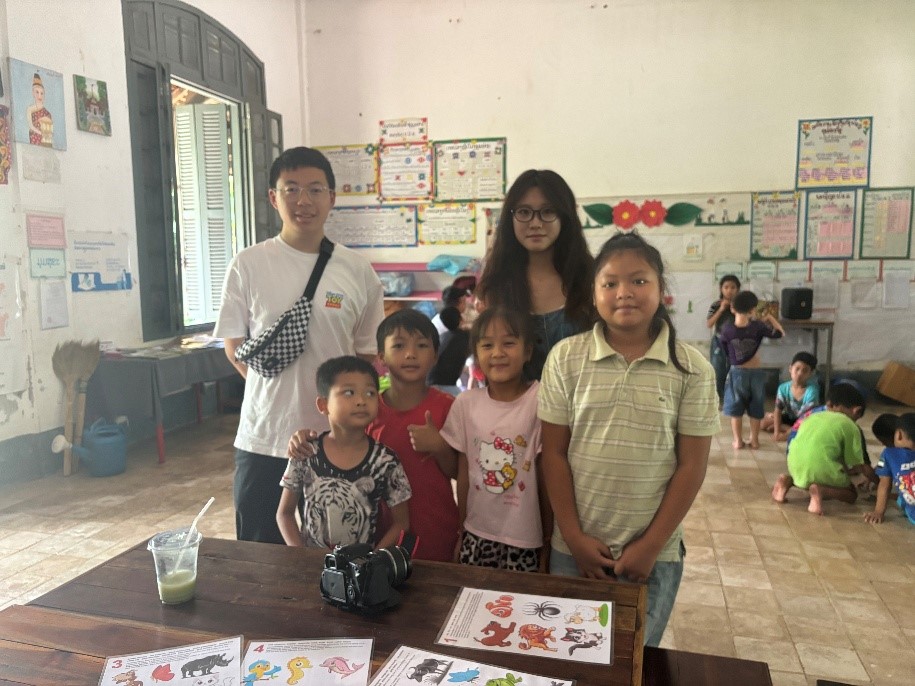
Duan Mingda and Su Shaowei (left and right from the back row) pose with Grade 1 students after completing a day of English enlightenment teaching
(Note:The author has obtained consent from the organization and the school for the use of this image)
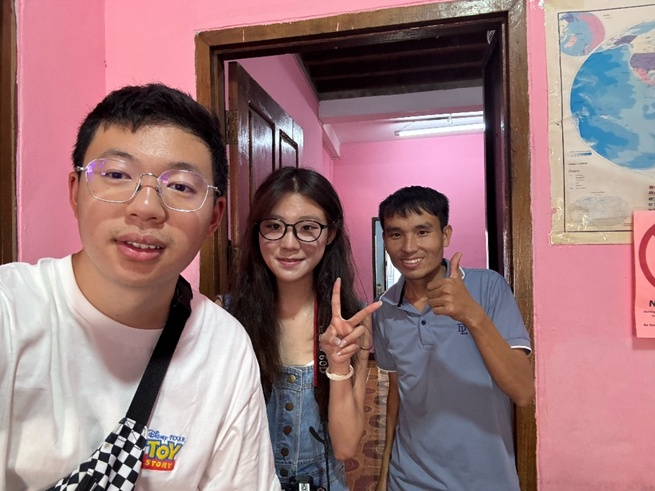
Duan Mingda (left) and Su Shaowei with a Hmong English teacher from “Big Brother Mouse” at the partner primary school in Luang Prabang
At the Unexploded Ordnance (UXO) Visitor Centre, Mingda confronted a different kind of history: the aftermath of the United States’s “Secret War” and the unexploded ordnance that continues to threaten Laotian communities and their agricultural and livestock industries for decades. Holding a Vietnam War-era Winchester rifle was a sobering reminder of how the past remains dangerously present.
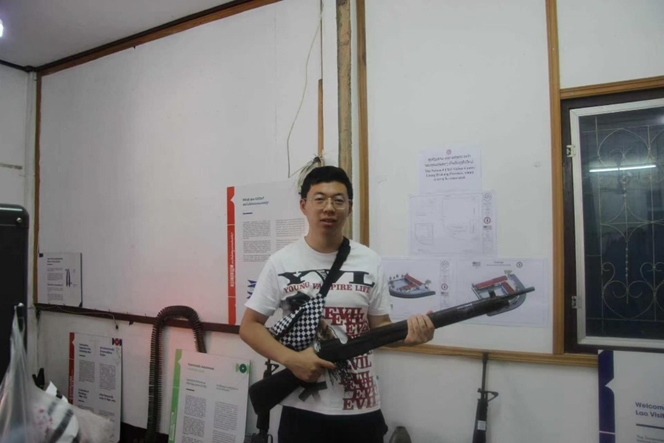
Duan Mingda holds a Winchester rifle from the Vietnam War era at the UXO Visitor Centre (Note: The handling of the rifle was part of a museum display, intended solely for historical documentation. We firmly oppose all illegal possession of firearms and acts of violence)
At Laos Buffalo Dairy, Mingda helped wash and cool the buffaloes—a simple act that revealed a larger story. There he met Zeng Qingkai, a Chinese graduate from Guangzhou who was working at the farm, he learned that Laos’s livestock industry remains underdeveloped. The farm promotes sustainability by renting buffaloes from local farmers and teaching improved husbandry techniques, turning a single buffalo into a source of hope.
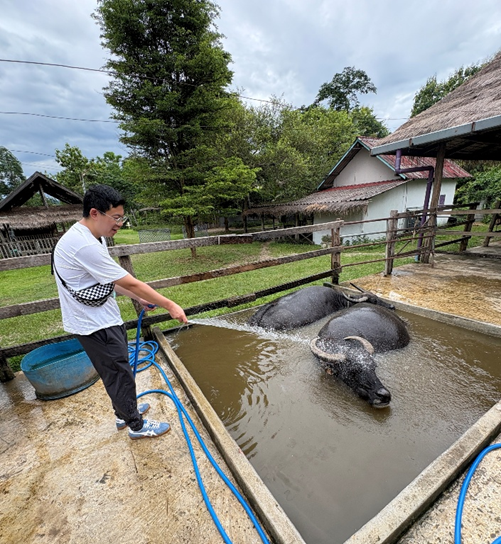
Mingda washing and cooling buffaloes at Laos Buffalo Dairy
From Museum to Cross-Border Train: Li Zhuhan’s Observations in Singapore and Johor Bahru
While on exchange at the National University of Singapore Faculty of Arts and Social Sciences (NUS FASS) in summer 2026, Li Zhuhan began connecting classroom discussions on Southeast Asian history, regional connectivity, and globalization into direct observation. He quickly discovered that the region’s complexities are best understood not through maps alone, but through daily movement and cultural exchange.
At the Singapore National Museum, Zhuhan visited the exhibition “Once Upon a Tide: Singapore’s Journey from Settlement to Global City.” Using on-site exhibits as source material, he completed an independent research assignment analyzing how Singapore’s hawker culture has been shaped into an internationally recognizable symbol through media, state narrative, and global cultural flows—examining the topic through economic, political, and cultural lenses.
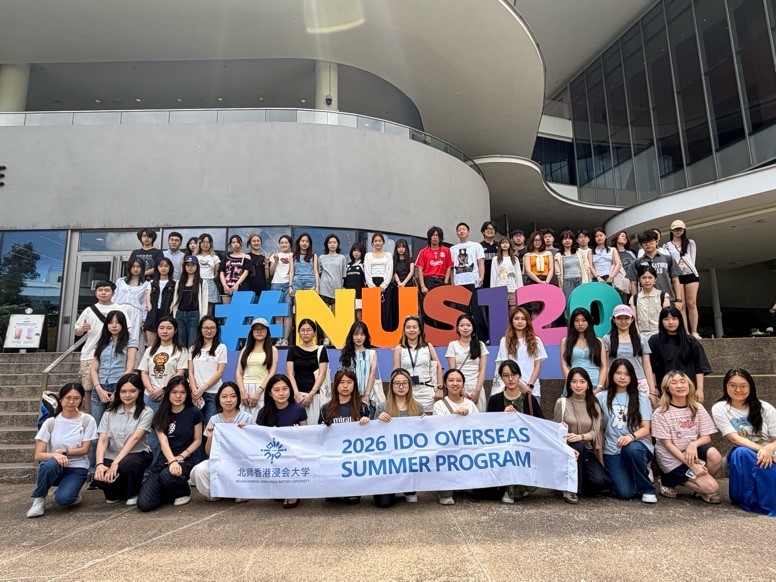
Li Zhuhan at the 2026 BNBU IDO Overseas Summer Program, NUS
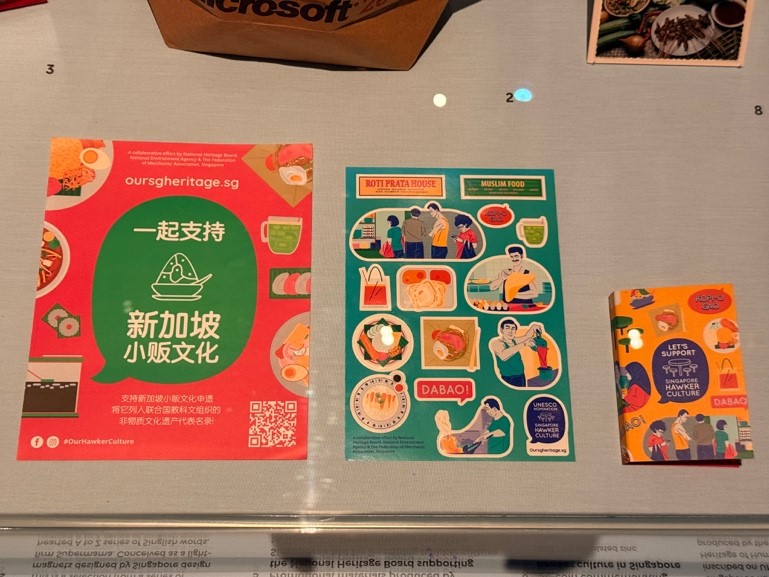
“Hawker culture” promotional materials displayed at the National Museum of Singapore
In another course project, Zhuhan treated Singapore’s MRT and bus systems as “urban media,” observing how card-swiping, real-time arrival information, and mobile applications collectively organize daily mobility. These assignments prompted him to recognize that both culture and infrastructure connect individual experience, urban governance, and wider global networks.
Beyond the classroom, Li Zhuhan made multiple trips on the KTM Shuttle Tebrau from Woodlands to Johor Bharu Sentral, travelling back and forth between Singapore and Malaysia. These brief journeys transformed abstract concepts like “borders,” “regional connectivity,” and “population mobility” into lived experiences. Against the promising backdrop of the upcoming Rapid Transit System Link (RTS Link), he gained an intuitive understanding of how cross-border transportation and daily migration ties evolving between the two countries.
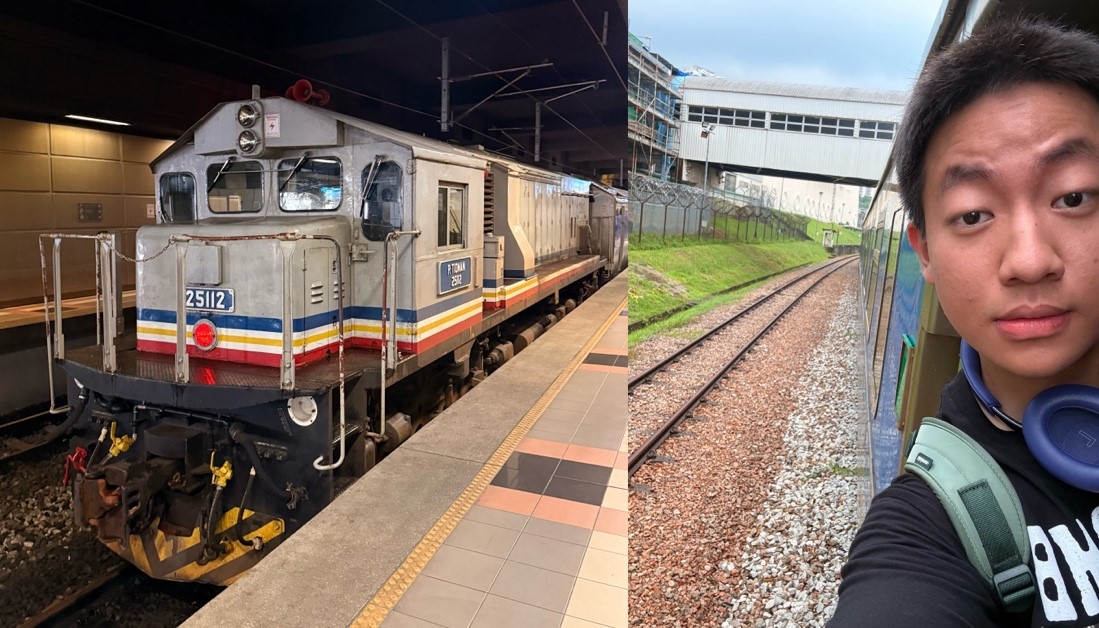
The KTM Shuttle Tebrau cross-border train (left), a selfie photographed during Li Zhuhan’s travels between Singapore and Johor Bahru (right)
Personal Reflection
“This field trip showed me the weight of educational equity and the preciousness of peace. Big Brother Mouse opens a window to the world for children through books, while Laos Buffalo Dairy ignites hope for farmers through the humble buffalo. This experience will continue to inspire my commitment to cross-cultural education and facing the world with a broader perspective.” —Duan Mingda
“This summer gave me a far more concrete understanding of Southeast Asia than any map could. The region exists not only in nations and borders, but in the exchange of food and culture, the movement of people through cities, and the transportation networks that connect them daily. From hawker-culture exhibits to public transport, to the Shuttle Tebrau crossing the causeway, I discovered that larger regional connections are always present behind everyday life. I used to see cross-border trains simply as transport, but after multiple journeys, I realized that every train carries connections between people, cultures, and cities. The most important change is that I now look at a place with questions, rather than simply arriving at it.” —Li Zhuhan
A Word from the Instructor
“As an instructor, there is no greater reward than seeing students transfrom classroom curiosity into real-world inquiry. Mingda and Zhuhan approached Southeast Asia not as passive travelers, but as thoughtful observers—engaging with educators in Laos, tracing cross-border flows between Singapore and Malaysia, and responding on what they saw with nuance and care. Their journeys remind us that history is not an inert data nor archives; it is human experience and intelligence waiting to be reinterpreted. I am proud of their initiative and hope their experiences inspire other BNBU students to step beyond the classroom and pursue their own meaningful engagements.”
— Dr. Wei Chin Wong, Instructor of “GFHC 1043: History of Southeast Asia.”
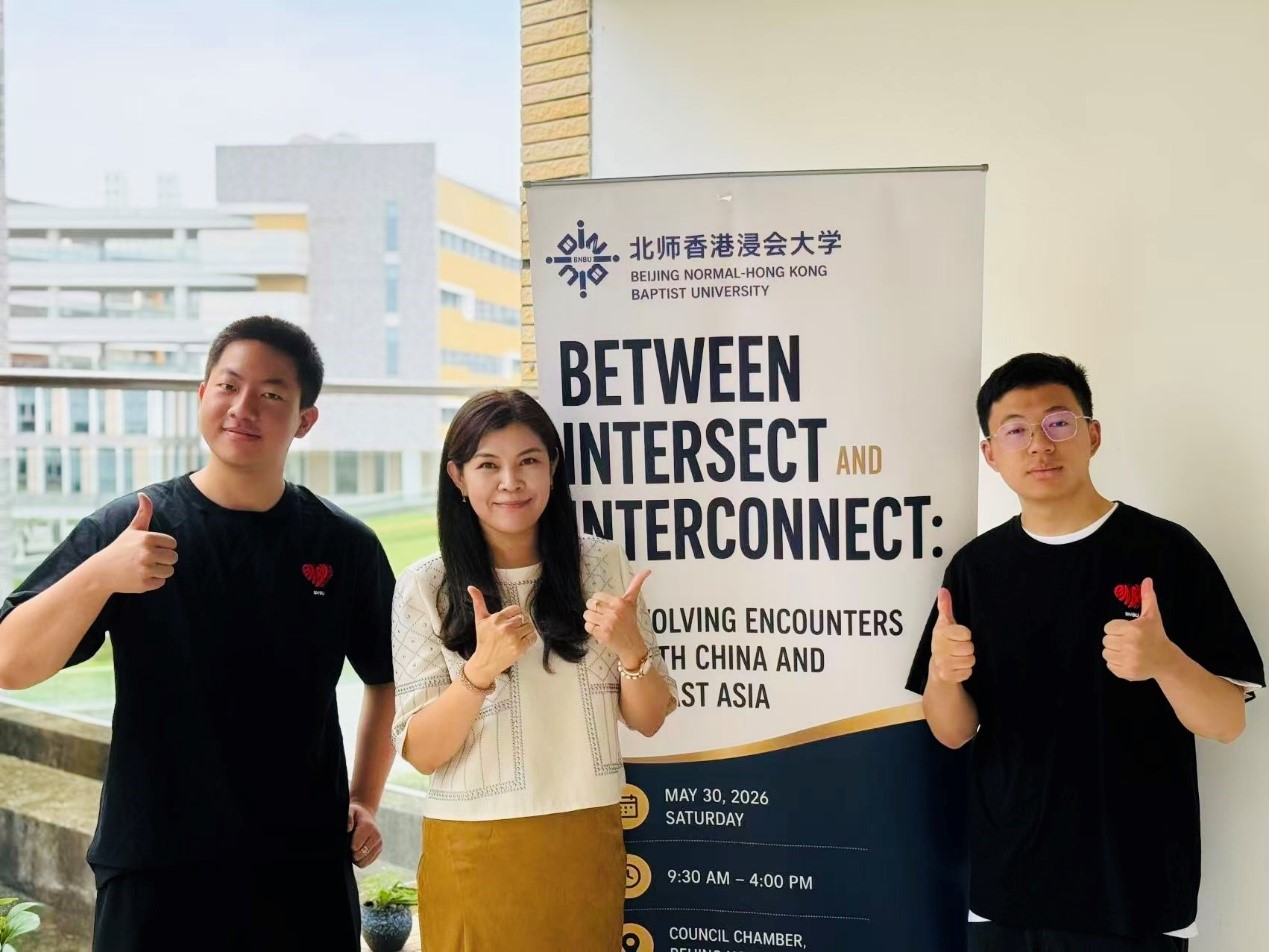
A moment after the international symposium “Between Intersect and Interconnect: The Evolving Encounters of South China and Southeast Asia,” held at BNBU in May 2026. Dr. Wei Chin Wong with Duan Mingda and Li Zhuhan
Special thanks to:
Big Brother Mouse
Laos Buffalo Dairy and staff member Mr. Zeng Qingkai
National University of Singapore Faculty of Arts and Social Sciences (NUS FASS)
National Museum of Singapore
Authors and Photos: Duan Mingda and Li Zhuhan
Editor: Wei Chin Wong
Reviewer: Jesse Owen Hearns-Branaman
